| # Terraform Resource Instance Change Lifecycle |
| |
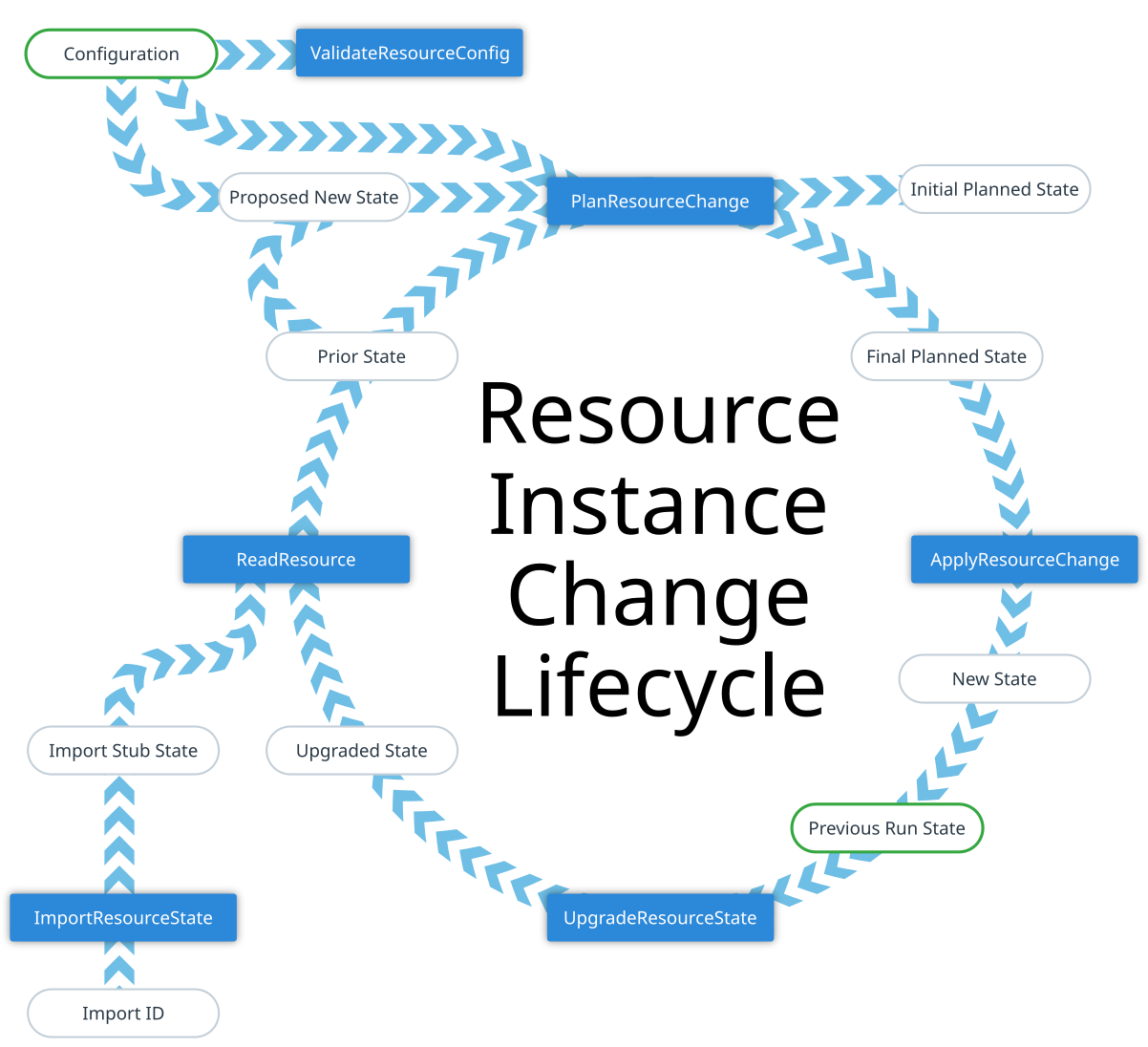
| This document describes the relationships between the different operations |
| called on a Terraform Provider to handle a change to a resource instance. |
| |
|  |
| |
| The resource instance operations all both consume and produce objects that |
| conform to the schema of the selected resource type. |
| |
| The overall goal of this process is to take a **Configuration** and a |
| **Previous Run State**, merge them together using resource-type-specific |
| planning logic to produce a **Planned State**, and then change the remote |
| system to match that planned state before finally producing the **New State** |
| that will be saved in order to become the **Previous Run State** for the next |
| operation. |
| |
| The various object values used in different parts of this process are: |
| |
| * **Configuration**: Represents the values the user wrote in the configuration, |
| after any automatic type conversions to match the resource type schema. |
| |
| Any attributes not defined by the user appear as null in the configuration |
| object. If an argument value is derived from an unknown result of another |
| resource instance, its value in the configuration object could also be |
| unknown. |
| |
| * **Prior State**: The provider's representation of the current state of the |
| remote object at the time of the most recent read. |
| |
| * **Proposed New State**: Terraform Core uses some built-in logic to perform |
| an initial basic merger of the **Configuration** and the **Prior State** |
| which a provider may use as a starting point for its planning operation. |
| |
| The built-in logic primarily deals with the expected behavior for attributes |
| marked in the schema as "computed". If an attribute is only "computed", |
| Terraform expects the value to only be chosen by the provider and it will |
| preserve any Prior State. If an attribute is marked as "computed" and |
| "optional", this means that the user may either set it or may leave it |
| unset to allow the provider to choose a value. |
| |
| Terraform Core therefore constructs the proposed new state by taking the |
| attribute value from Configuration if it is non-null, and then using the |
| Prior State as a fallback otherwise, thereby helping a provider to |
| preserve its previously-chosen value for the attribute where appropriate. |
| |
| * **Initial Planned State** and **Final Planned State** are both descriptions |
| of what the associated remote object ought to look like after completing |
| the planned action. |
| |
| There will often be parts of the object that the provider isn't yet able to |
| predict, either because they will be decided by the remote system during |
| the apply step or because they are derived from configuration values from |
| other resource instances that are themselves not yet known. The provider |
| must mark these by including unknown values in the state objects. |
| |
| The distinction between the _Initial_ and _Final_ planned states is that |
| the initial one is created during Terraform Core's planning phase based |
| on a possibly-incomplete configuration, whereas the final one is created |
| during the apply step once all of the dependencies have already been |
| updated and so the configuration should then be wholly known. |
| |
| * **New State** is a representation of the result of whatever modifications |
| were made to the remote system by the provider during the apply step. |
| |
| The new state must always be wholly known, because it represents the |
| actual state of the system, rather than a hypothetical future state. |
| |
| * **Previous Run State** is the same object as the **New State** from |
| the previous run of Terraform. This is exactly what the provider most |
| recently returned, and so it will not take into account any changes that |
| may have been made outside of Terraform in the meantime, and it may conform |
| to an earlier version of the resource type schema and therefore be |
| incompatible with the _current_ schema. |
| |
| * **Upgraded State** is derived from **Previous Run State** by using some |
| provider-specified logic to upgrade the existing data to the latest schema. |
| However, it still represents the remote system as it was at the end of the |
| last run, and so still doesn't take into account any changes that may have |
| been made outside of Terraform. |
| |
| * The **Import ID** and **Import Stub State** are both details of the special |
| process of importing pre-existing objects into a Terraform state, and so |
| we'll wait to discuss those in a later section on importing. |
| |
| |
| ## Provider Protocol API Functions |
| |
| The following sections describe the three provider API functions that are |
| called to plan and apply a change, including the expectations Terraform Core |
| enforces for each. |
| |
| For historical reasons, the original Terraform SDK is exempt from error |
| messages produced when certain assumptions are violated, but violating them |
| will often cause downstream errors nonetheless, because Terraform's workflow |
| depends on these contracts being met. |
| |
| The following section uses the word "attribute" to refer to the named |
| attributes described in the resource type schema. A schema may also include |
| nested blocks, which contain their _own_ set of attributes; the constraints |
| apply recursively to these nested attributes too. |
| |
| The following are the function names used in provider protocol version 6. |
| Protocol version 5 has the same set of operations but uses some |
| marginally-different names for them, because we used protocol version 6 as an |
| opportunity to tidy up some names that had been awkward before. |
| |
| ### ValidateResourceConfig |
| |
| `ValidateResourceConfig` takes the **Configuration** object alone, and |
| may return error or warning diagnostics in response to its attribute values. |
| |
| `ValidateResourceConfig` is the provider's opportunity to apply custom |
| validation rules to the schema, allowing for constraints that could not be |
| expressed via schema alone. |
| |
| In principle a provider can make any rule it wants here, although in practice |
| providers should typically avoid reporting errors for values that are unknown. |
| Terraform Core will call this function multiple times at different phases |
| of evaluation, and guarantees to _eventually_ call with a wholly-known |
| configuration so that the provider will have an opportunity to belatedly catch |
| problems related to values that are initially unknown during planning. |
| |
| If a provider intends to choose a default value for a particular |
| optional+computed attribute when left as null in the configuration, the |
| provider _must_ tolerate that attribute being unknown in the configuration in |
| order to get an opportunity to choose the default value during the later |
| plan or apply phase. |
| |
| The validation step does not produce a new object itself and so it cannot |
| modify the user's supplied configuration. |
| |
| ### PlanResourceChange |
| |
| The purpose of `PlanResourceChange` is to predict the approximate effect of |
| a subsequent apply operation, allowing Terraform to render the plan for the |
| user and to propagate the predictable subset of results downstream through |
| expressions in the configuration. |
| |
| This operation can base its decision on any combination of **Configuration**, |
| **Prior State**, and **Proposed New State**, as long as its result fits the |
| following constraints: |
| |
| * Any attribute that was non-null in the configuration must either preserve |
| the exact configuration value or return the corresponding attribute value |
| from the prior state. (Do the latter if you determine that the change is not |
| functionally significant, such as if the value is a JSON string that has |
| changed only in the positioning of whitespace.) |
| |
| * Any attribute that is marked as computed in the schema _and_ is null in the |
| configuration may be set by the provider to any arbitrary value of the |
| expected type. |
| |
| * If a computed attribute has any _known_ value in the planned new state, the |
| provider will be required to ensure that it is unchanged in the new state |
| returned by `ApplyResourceChange`, or return an error explaining why it |
| changed. Set an attribute to an unknown value to indicate that its final |
| result will be determined during `ApplyResourceChange`. |
| |
| `PlanResourceChange` is actually called twice per run for each resource type. |
| |
| The first call is during the planning phase, before Terraform prints out a |
| diff to the user for confirmation. Because no changes at all have been applied |
| at that point, the given **Configuration** may contain unknown values as |
| placeholders for the results of expressions that derive from unknown values |
| of other resource instances. The result of this initial call is the |
| **Initial Planned State**. |
| |
| If the user accepts the plan, Terraform will call `PlanResourceChange` a |
| second time during the apply step, and that call is guaranteed to have a |
| wholly-known **Configuration** with any values from upstream dependencies |
| taken into account already. The result of this second call is the |
| **Final Planned State**. |
| |
| Terraform Core compares the final with the initial planned state, enforcing |
| the following additional constraints along with those listed above: |
| |
| * Any attribute that had a known value in the **Initial Planned State** must |
| have an identical value in the **Final Planned State**. |
| |
| * Any attribute that had an unknown value in the **Initial Planned State** may |
| either remain unknown in the second _or_ take on any known value that |
| conforms to the unknown value's type constraint. |
| |
| The **Final Planned State** is what passes to `ApplyResourceChange`, as |
| described in the following section. |
| |
| ### ApplyResourceChange |
| |
| The `ApplyResourceChange` function is responsible for making calls into the |
| remote system to make remote objects match the **Final Planned State**. During |
| that operation, the provider should decide on final values for any attributes |
| that were left unknown in the **Final Planned State**, and thus produce the |
| **New State** object. |
| |
| `ApplyResourceChange` also receives the **Prior State** so that it can use it |
| to potentially implement more "surgical" changes to particular parts of |
| the remote objects by detecting portions that are unchanged, in cases where the |
| remote API supports partial-update operations. |
| |
| The **New State** object returned from the provider must meet the following |
| constraints: |
| |
| * Any attribute that had a known value in the **Final Planned State** must have |
| an identical value in the new state. In particular, if the remote API |
| returned a different serialization of the same value then the provider must |
| preserve the form the user wrote in the configuration, and _must not_ return |
| the normalized form produced by the provider. |
| |
| * Any attribute that had an unknown value in the **Final Planned State** must |
| take on a known value whose type conforms to the type constraint of the |
| unknown value. No unknown values are permitted in the **New State**. |
| |
| After calling `ApplyResourceChange` for each resource instance in the plan, |
| and dealing with any other bookkeeping to return the results to the user, |
| a single Terraform run is complete. Terraform Core saves the **New State** |
| in a state snapshot for the entire configuration, so it'll be preserved for |
| use on the next run. |
| |
| When the user subsequently runs Terraform again, the **New State** becomes |
| the **Previous Run State** verbatim, and passes into `UpgradeResourceState`. |
| |
| ### UpgradeResourceState |
| |
| Because the state values for a particular resource instance persist in a |
| saved state snapshot from one run to the next, Terraform Core must deal with |
| the possibility that the user has upgraded to a newer version of the provider |
| since the last run, and that the new provider version has an incompatible |
| schema for the relevant resource type. |
| |
| Terraform Core therefore begins by calling `UpgradeResourceState` and passing |
| the **Previous Run State** in a _raw_ form, which in current protocol versions |
| is the raw JSON data structure as was stored in the state snapshot. Terraform |
| Core doesn't have access to the previous schema versions for a provider's |
| resource types, so the provider itself must handle the data decoding in this |
| upgrade function. |
| |
| The provider can then use whatever logic is appropriate to update the shape |
| of the data to conform to the current schema for the resource type. Although |
| Terraform Core has no way to enforce it, a provider should only change the |
| shape of the data structure and should _not_ change the meaning of the data. |
| In particular, it should not try to update the state data to capture any |
| changes made to the corresponding remote object outside of Terraform. |
| |
| This function then returns the **Upgraded State**, which captures the same |
| information as the **Previous Run State** but does so in a way that conforms |
| to the current version of the resource type schema, which therefore allows |
| Terraform Core to interact with the data fully for subsequent steps. |
| |
| No unknown values are permitted in the **Updated State**. |
| |
| ### ReadResource |
| |
| Although Terraform typically expects to have exclusive control over any remote |
| object that is bound to a resource instance, in practice users may make changes |
| to those objects outside of Terraform, causing Terraform's records of the |
| object to become stale. |
| |
| The `ReadResource` function asks the provider to make a best effort to detect |
| any such external changes and describe them so that Terraform Core can use |
| an up-to-date **Prior State** as the input to the next `PlanResourceChange` |
| call. |
| |
| This is always a best effort operation because there are various reasons why |
| a provider might not be able to detect certain changes. For example: |
| * Some remote objects have write-only attributes, which means that there is |
| no way to determine what value is currently stored in the remote system. |
| * There may be new features of the underlying API which the current provider |
| version doesn't know how to ask about. |
| |
| Terraform Core expects a provider to carefully distinguish between the |
| following two situations for each attribute: |
| * **Normalization**: the remote API has returned some data in a different form |
| than was recorded in the **Previous Run State**, but the meaning is unchanged. |
| |
| In this case, the provider should return the exact value from the |
| **Previous Run State**, thereby preserving the value as it was written by |
| the user in the configuration and thus avoiding unwanted cascading changes to |
| elsewhere in the configuration. |
| * **Drift**: the remote API returned data that is materially different from |
| what was recorded in the **Previous Run State**, meaning that the remote |
| system's behavior no longer matches what the configuration previously |
| requested. |
| |
| In this case, the provider should return the value from the remote system, |
| thereby discarding the value from the **Previous Run State**. When a |
| provider does this, Terraform _may_ report it to the user as a change |
| made outside of Terraform, if Terraform Core determined that the detected |
| change was a possible cause of another planned action for a downstream |
| resource instance. |
| |
| This operation returns the **Prior State** to use for the next call to |
| `PlanResourceChange`, thus completing the circle and beginning this process |
| over again. No unknown values are permitted in the **Prior State**. |
| |
| ## Handling of Nested Blocks in Configuration |
| |
| Nested blocks are a configuration-only construct and so the number of blocks |
| cannot be changed on the fly during planning or during apply: each block |
| represented in the configuration must have a corresponding nested object in |
| the planned new state and new state, or Terraform Core will raise an error. |
| |
| If a provider wishes to report about new instances of the sub-object type |
| represented by nested blocks that are created implicitly during the apply |
| operation -- for example, if a compute instance gets a default network |
| interface created when none are explicitly specified -- this must be done via |
| separate "computed" attributes alongside the nested blocks. This could be list |
| or map of objects that includes a mixture of the objects described by the |
| nested blocks in the configuration and any additional objects created implicitly |
| by the remote system. |
| |
| Provider protocol version 6 introduced the new idea of structural-typed |
| attributes, which are a hybrid of attribute-style syntax but nested-block-style |
| interpretation. For providers that use structural-typed attributes, they must |
| follow the same rules as for a nested block type of the same nesting mode. |
| |
| ## Import Behavior |
| |
| The main resource instance change lifecycle is concerned with objects whose |
| entire lifecycle is driven through Terraform, including the initial creation |
| of the object. |
| |
| As an aid to those who are adopting Terraform as a replacement for existing |
| processes or software, Terraform also supports adopting pre-existing objects |
| to bring them under Terraform's management without needing to recreate them |
| first. |
| |
| When using this facility, the user provides the address of the resource |
| instance they wish to bind the existing object to, and a string representation |
| of the identifier of the existing object to be imported in a syntax defined |
| by the provider on a per-resource-type basis, which we'll call the |
| **Import ID**. |
| |
| The import process trades the user's **Import ID** for a special |
| **Import Stub State**, which behaves as a placeholder for the |
| **Previous Run State** pretending as if a previous Terraform run is what had |
| created the object. |
| |
| ### ImportResourceState |
| |
| The `ImportResourceState` operation takes the user's given **Import ID** and |
| uses it to verify that the given object exists and, if so, to retrieve enough |
| data about it to produce the **Import Stub State**. |
| |
| Terraform Core will always pass the returned **Import Stub State** to the |
| normal `ReadResource` operation after `ImportResourceState` returns it, so |
| in practice the provider may populate only the minimal subset of attributes |
| that `ReadResource` will need to do its work, letting the normal function |
| deal with populating the rest of the data to match what is currently set in |
| the remote system. |
| |
| For the same reasons that `ReadResource` is only a _best effort_ at detecting |
| changes outside of Terraform, a provider may not be able to fully support |
| importing for all resource types. In that case, the provider developer must |
| choose between the following options: |
| |
| * Perform only a partial import: the provider may choose to leave certain |
| attributes set to `null` in the **Prior State** after both |
| `ImportResourceState` and the subsequent `ReadResource` have completed. |
| |
| In this case, the user can provide the missing value in the configuration |
| and thus cause the next `PlanResourceChange` to plan to update that value |
| to match the configuration. The provider's `PlanResourceChange` function |
| must be ready to deal with the attribute being `null` in the |
| **Prior State** and handle that appropriately. |
| * Return an error explaining why importing isn't possible. |
| |
| This is a last resort because of course it will then leave the user unable |
| to bring the existing object under Terraform's management. However, if a |
| particular object's design doesn't suit importing then it can be a better |
| user experience to be clear and honest that the user must replace the object |
| as part of adopting Terraform, rather than to perform an import that will |
| leave the object in a situation where Terraform cannot meaningfully manage |
| it. |
